How often should you service a transmission that tows?
As a working interval, service a towing truck's automatic transmission every 60,000–80,000 km. If you tow heavy loads regularly, tow in hilly country, or live somewhere hot like the Sunshine Coast in summer, bring that forward to 50,000–60,000 km. If the truck never tows and is driven gently, the factory fill-for-life or 100,000 km-plus interval is more defensible, though we still recommend a fluid condition check well before that point.
What does “fill-for-life” actually mean?
Fill-for-life is a marketing-friendly way of saying the manufacturer doesn't specify a routine drain-and-fill under its default duty-cycle assumptions. Those assumptions are built around an average, largely unladen vehicle in a temperate climate doing a mix of commuting and highway driving. A RAM, Silverado, GMC or F-Series towing a caravan up the range in Queensland summer heat is a completely different duty cycle, and the fluid knows it long before the computer does.
Why does towing wear out fluid faster than kilometres alone?
Automatic transmission fluid fails mostly on heat cycles and shear, not on distance. Every time a torque converter works hard under load — climbing a range, holding a gear on a descent, or crawling with a loaded trailer through traffic — fluid temperature spikes well above normal cruising temperature. Repeated heat spikes oxidise the fluid, break down the friction modifiers that let clutch packs grip cleanly, and eventually leave you with fluid that looks fine on the dipstick but has lost its ability to protect the transmission.
Is it legal or safe to just follow the factory interval anyway?
It's legal — there's no regulation forcing an earlier service — but it isn't necessarily safe for the transmission's longevity, and it can cost you a warranty claim. Manufacturers generally classify frequent towing, high ambient temperatures and hilly terrain as severe-duty use, which typically carries a shorter recommended interval buried in the severe-duty section of the owner's manual, separate from the standard fill-for-life figure most people read.
Our recommended service intervals
| Use | Interval |
|---|---|
| Daily driving, no towing | Around 100,000 km |
| Regular towing or work use | 60,000–80,000 km |
| Heavy towing, hot climate, hills | 50,000–60,000 km |
| Ex-fleet or unknown fluid history | Immediate fluid condition check |
How much does a transmission service cost?
A transmission service is separate from our published minor service pricing and is quoted on enquiry, because the correct job varies by model, generation and fluid type — some trucks need a simple pan-drop and filter, others use a sealed unit that requires a controlled machine exchange to hit the correct fill volume. Call us on 0495 055 559 or drop in at 46 Regent St, Caloundra and we'll quote your specific truck and transmission after checking fluid condition and service history.
Which is better: pan-drop service or full fluid exchange?
Neither is universally “better” — it depends on the transmission's condition and design.
| Method | What it does | Best suited to |
|---|---|---|
| Pan-drop with filter change | Drains the pan (typically 40–60% of total fluid), replaces filter, refills | Higher-kilometre or neglected transmissions where a sudden full exchange risks dislodging debris |
| Controlled machine fluid exchange | Exchanges close to 100% of fluid using a transmission fluid exchange machine | Well-maintained transmissions on a normal interval, and units without a serviceable pan |
| High-pressure flush (uncontrolled) | Forces old fluid out under pressure without machine control | Not recommended by us on high-kilometre or unknown-history transmissions |
We generally prefer a pan-drop with filter change and controlled fluid exchange over a high-pressure flush on neglected transmissions, because a flush on tired clutch material can dislodge debris that a healthy transmission would have tolerated.
What happens if you never service a towing transmission?
Skipping servicing on a truck that tows doesn't usually end in a sudden failure with no warning — it ends in a slow decline that owners often mistake for “that's just how it drives now”. Shift quality degrades, shudder appears under light throttle, and the transmission runs hotter for the same towing job because degraded fluid transfers heat less effectively. Left long enough, clutch pack wear becomes mechanical damage, and a fluid service can no longer fix what a rebuild or reconditioned unit now needs to.
What are the symptoms of tired transmission fluid?
- Shudder at light throttle around 60–90 km/h
- Delayed engagement into drive or reverse
- Flaring between gears under load
- Transmission temperature climbing faster than it used to on the same tow
- Dark fluid with a burnt smell on the dipstick or during a service
- Harsher or hunting shifts while towing on hills
Does fluid colour alone tell you it needs changing?
Not reliably. Some fluids darken with normal use and are still within spec, while others can look reasonably clear yet have lost their friction properties. Smell and a proper fluid condition check matter more than colour alone, which is one reason we assess fluid rather than just going on kilometres when a truck comes in for driveline work.
Does fluid specification matter as much as brand?
Yes — arguably more. Modern 8- and 10-speed transmissions fitted to current RAM, Silverado, GMC and F-Series trucks are calibrated around a specific fluid specification, not a generic “ATF”. A near-enough substitute that isn't the correct spec can cause shudder and rough shifting long before it triggers a fault code, because the friction modifiers don't match what the clutch packs were tuned for. We match fluid to the transmission's actual specification, not just what's cheapest on the shelf.
Does towing void the transmission warranty?
No — towing within the truck's rated GVM, GCM and towing capacity is considered normal use. What can void a claim is failing to service the transmission at the interval the manufacturer specifies for severe-duty use, or towing overloaded. Keeping documented service history at the correct interval is your best protection if a warranty question ever comes up.
Is cooling part of the answer, or just fluid changes?
Cooling is at least half the answer. Fresh fluid buys you time, but if your transmission consistently runs hot while towing, the underlying cause is a heat problem, not a fluid-age problem. An auxiliary transmission cooler, a clean radiator core, correct fan operation and a transmission temperature gauge (rather than relying on a generic dash warning) do more for long-term transmission life on a regularly towing truck than any additive.
Servicing towing trucks on the Sunshine Coast
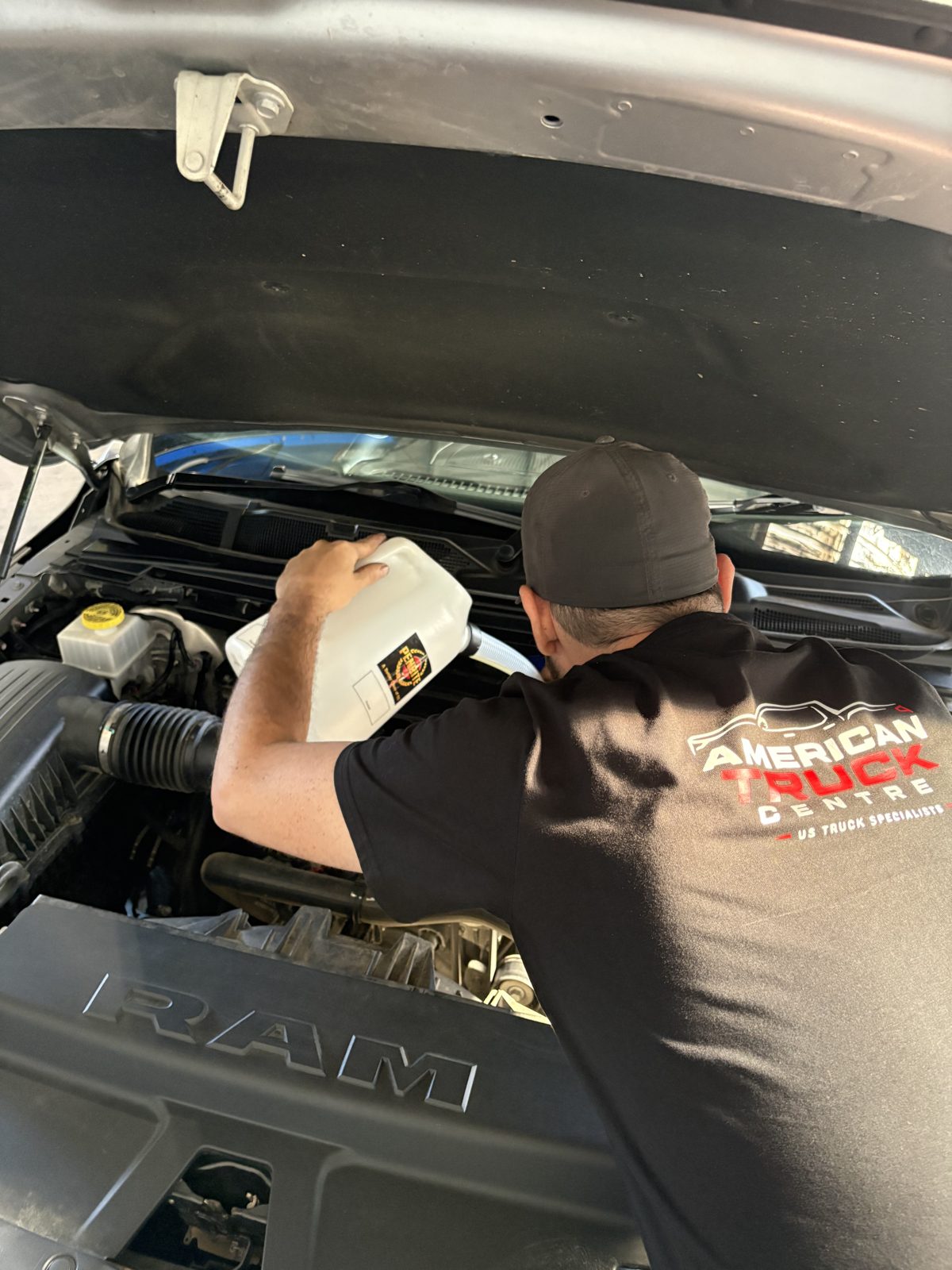
American Truck Centre in Caloundra services RAM, Chevrolet Silverado, GMC and Ford F-Series pickups for Sunshine Coast owners who actually use their trucks for towing — caravans, boats and trailers up and down the range in Queensland heat. We check fluid condition against kilometres and duty cycle rather than applying a blanket interval, and we can also assess and fit auxiliary transmission cooling where a truck's tow use warrants it. Book a transmission check or service on 0495 055 559, or visit us at 46 Regent St, Caloundra.
Frequently asked questions
- Is a transmission flush safe on a high-kilometre truck?
- Not always. We generally prefer a pan-drop with filter change and a controlled fluid exchange over a high-pressure flush on neglected or high-kilometre transmissions, because a flush can dislodge debris that worn clutch material has been tolerating. We assess fluid condition and service history first, then recommend the safer method for that specific transmission.
- Does towing void the transmission warranty?
- No, towing within rated limits is normal use — but a manufacturer can decline a warranty claim if servicing wasn't carried out at the correct severe-duty interval or the truck was towing overloaded. Keeping documented service history at the towing interval is the best protection if a claim is ever needed.
- How much does a transmission service cost at American Truck Centre?
- Transmission servicing is quoted on enquiry rather than a fixed price, because the correct job — pan-drop or full fluid exchange, and the specific fluid required — varies by model and generation. Call 0495 055 559 or visit 46 Regent St, Caloundra and we'll quote after checking your truck and its service history.
- How often should a towing truck's transmission be serviced?
- Every 60,000–80,000 km for trucks that tow regularly, tightening to 50,000–60,000 km for heavy towing, hilly country or hot climates like the Sunshine Coast. Trucks that never tow can generally follow the longer factory fill-for-life guidance, though we still recommend an occasional fluid condition check.
- What are the warning signs my transmission fluid needs changing?
- Shudder at light throttle around 60–90 km/h, delayed engagement into drive or reverse, flaring between gears, transmission temperatures climbing faster than they used to, and dark, burnt-smelling fluid. Any of these while towing is a reason to get the fluid and cooling system checked promptly.
- Can a transmission cooler reduce how often I need to service the fluid?
- A cooler won't extend a fixed interval on its own, but it directly reduces the heat cycling that ages fluid fastest, so a well-cooled transmission is less likely to need an earlier-than-recommended service due to heat damage. We can assess whether your towing use justifies fitting an auxiliary cooler.
- Is it legal to skip the transmission service if the manual says fill-for-life?
- Yes, it's legal — there's no law requiring an earlier service — but fill-for-life assumes light, average duty-cycle use, not regular towing. Following it regardless on a towing truck isn't illegal, just risky for transmission longevity and potentially for a future warranty claim if severe-duty servicing wasn't documented.
- What happens if a towing transmission is never serviced?
- It doesn't usually fail suddenly — shift quality declines gradually, shudder appears, and running temperatures rise for the same towing job as fluid loses its protective properties. Left long enough, this becomes clutch pack wear and mechanical damage that a fluid service alone can no longer fix.
About the author
Lachlan Matthews — Owner
Lachlan owns American Truck Centre in Caloundra and has spent more than 10 years working on American trucks and full-size US pickups. He oversees every job that comes through the workshop, from logbook servicing and diagnostics to suspension, towing setups and transmission work.
Related pages
More guides
RAM 2500 & 3500 Towing Capacity in Australia: Factory Ratings, Hitch Setup & Towing Guide
The brochure number is rarely your real limit. Braked vs unbraked, ball weight, 50mm vs 70mm hitches and how to set up a RAM 2500 or 3500 for heavy caravans.
DPF Problems in American Diesel Trucks: Causes, Symptoms and Legal Fixes
Short trips and stop-start driving are the fastest way to block a DPF. Here's what's actually happening, and what to do about it.
What Does It Cost to Service a RAM 1500 in Australia?
A straight answer on RAM 1500 servicing costs, what's included, and how to keep your warranty intact outside the dealer.